
Common misconception first: many traders assume “one exchange, one risk profile.” In practice, the same OKX account exposes you to at least three distinct systems — spot markets, derivatives (futures and options), and Web3 wallets/DEX interactions — each with different mechanics, incentives, and failure modes. Treating them as a single instrument is a recipe for surprise. This article lays out how those systems work under the hood, how their trade-offs differ for a US-based trader, and what to watch when you log in and move capital between them.
The aim is practical: give you a reusable mental model that distinguishes custody, leverage, settlement, and cross-chain complexity so you can make deliberate decisions (not emotional ones) at the moment you click “trade,” “stake,” or connect a wallet. Where evidence is solid, I state it. Where outcomes depend on choices or contingencies, I make that dependence explicit.
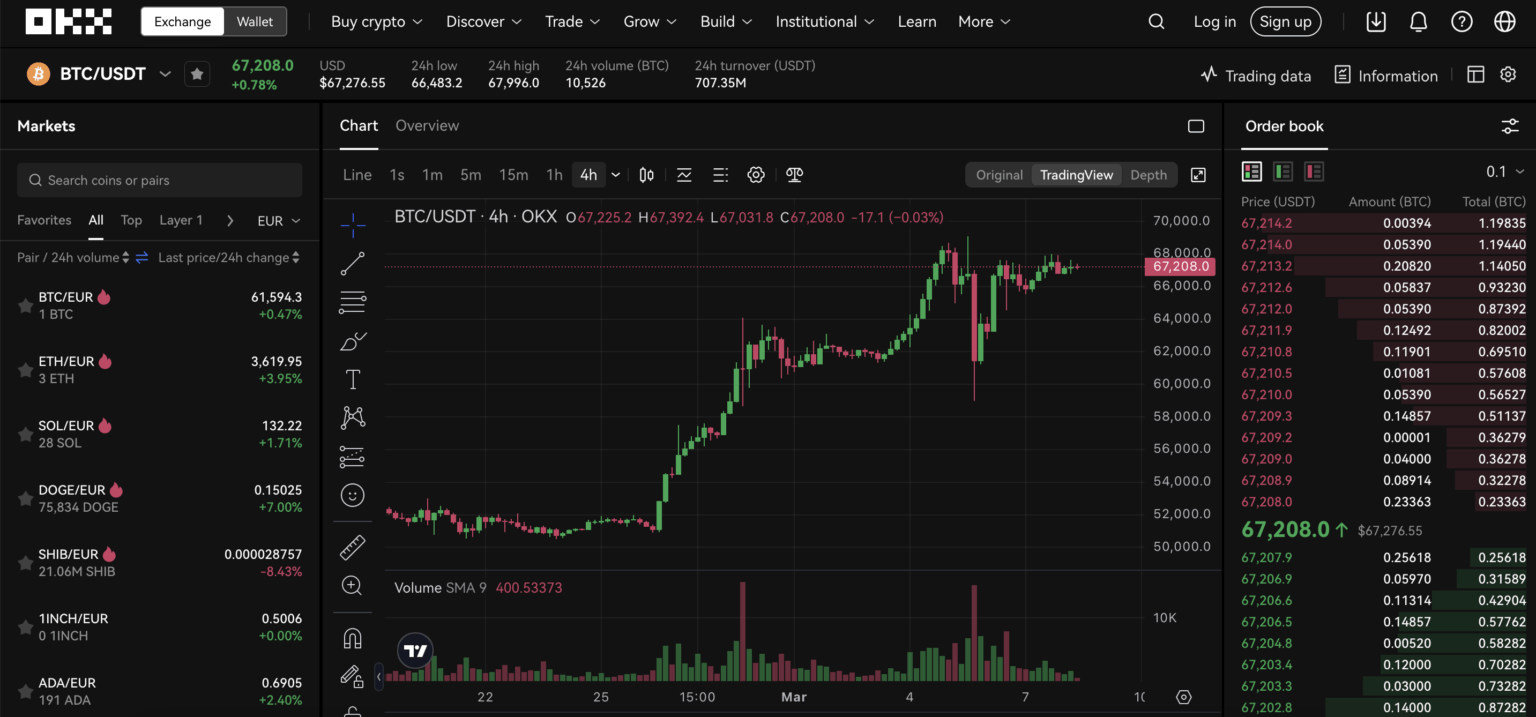
How each system actually works — mechanism-level clarity
Spot trading on OKX is the baseline: you place a market or limit order and the trade settles immediately on the exchange’s order book. That’s simple custody mechanics — you hand control of the asset to the exchange, and your exposure is a direct claim on deposited tokens. Margin within spot is different: borrowing increases exposure via a loan and introduces liquidation mechanics; OKX allows up to 10x on margin depending on asset and mode (isolated vs cross-margin). The essential mechanism to keep in mind is credit risk + market risk: the borrow magnifies price moves and the platform enforces maintenance margins automatically.
Futures and options are a different architecture. Perpetual swaps and quarterly futures on OKX are derivatives contracts that track underlying prices but settle differently. Perpetuals use a funding rate mechanism to tether contract price to spot; funding flows between longs and shorts depending on basis. OKX’s derivatives can offer up to 125x leverage on selected contracts — a mechanism that increases sensitivity to mark-price moves and compresses the margin window before liquidation. Two practical mechanics to internalize: (1) mark-price maintenance — liquidations are based on a mark price that tries to suppress manipulation at the expense of occasional divergence from the spot, and (2) cross-margin versus isolated — one spreads risk across positions, the other isolates it but forces per-position risk management.
OKX Web3 components change the trust model. The exchange runs a centralized custody service for CEX assets, but also offers a non‑custodial Web3 wallet where you hold private keys or integrate a hardware wallet. The DEX aggregator sources liquidity from Uniswap and others, finding swap routes and enabling cross-chain transfers. When you interact with the DEX, your exposure moves from custodial account risk to smart-contract and bridging risk: smart contract bugs, oracle failures, and bridge-rail vulnerabilities become the dominant threats, not exchange insolvency.
Trade-offs and best-fit scenarios: when to use spot, futures, or Web3
Think in terms of five axes: leverage sensitivity, custody control, liquidity predictability, regulatory friction, and technical complexity.
Spot is best when you want straightforward ownership, long-term exposure, staking, or yield generation. Because OKX holds >95% of assets in cold storage with multi-signature approvals and publishes Proof of Reserves, custody risk from exchange hacks is mitigated relative to unvetted platforms — though not eliminated. Use spot if you prioritize simplicity and intend to stake or use exchange services like NFT marketplace or flexible staking.
Futures are for tactical, event-driven traders who want pure directional exposure with capital efficiency. The trade-off is binary: small price moves can wipe equity under high leverage. OKX offers options and both quarterly and perpetual futures; the funding rate and mark-price systems aim to manage basis risk but introduce complexity. Use futures when you need leverage to express a view, but limit leverage and size relative to your capital and risk tolerance. For US traders, be mindful of regulatory constraints and the fact that KYC is mandatory; account flags can influence product availability.
Web3 flows are appropriate when you need custody control, smart-contract-enabled strategies (e.g., yield farming), or to interact with DApps across >130 supported blockchains. The trade-off here is the transfer of responsibility: you gain freedom (and potential yield) but accept irreversible loss risk if you lose seed phrases or authorize a malicious contract. Browser extension and mobile access make Web3 convenient, but phishing and UI-griefing remain common external risks.
Security and login mechanics: practical steps before you click “trade”
Your account protection is layered: military-grade encryption, real-time AI threat detection, and mandatory 2FA (SMS, Google Authenticator, or biometrics). That reduces unauthorized access but does not remove human error. For US traders: complete KYC with accurate ID and liveness checks to avoid verification friction later. If you plan to separate custody, create and test a non-custodial wallet and consider hardware keys (Ledger, Trezor) for significant holdings.
Before you log in, decide a session plan: do I need only spot execution? Or will I move funds to a Web3 wallet for a DeFi interaction? If you need both, use two distinct accounts or at least two browser profiles and keep 2FA methods independent. When you are ready to sign in, use the official access point and, for convenience, learn the platform’s Web login and mobile biometric options — they reduce risk of password reuse and phishing. For immediate access instructions and account entry, you can use the official guidance at okx login.
Where things break: concrete limits and failure modes
Cold storage and Proof of Reserves are strong mitigations but not perfect safeguards. Cold wallets protect against remote hacks, but operational risk exists: human error during withdrawals, multi-signature compromise, or legal seizure can still affect assets. Proof of Reserves shows backing at a point in time but does not guarantee operational continuity or immediate redemption if withdrawal systems are impaired.
Derivatives break under liquidity stress. When markets gap or liquidity providers withdraw, bid-ask spreads widen and slippage increases; mark-price mechanisms can delay or accelerate liquidations in ways traders do not expect. High leverage compresses the margin cushion; even modest funding-rate swings can compound P&L rapidly. There is also counterparty concentration risk: in stressed markets, exchange matching engines, insurers, or insurance funds may behave differently than assumed.
Web3 interactions introduce composability risk. Bridges and DEX aggregators expose you to smart contract bugs and oracle manipulation. Aggregators reduce swap costs by routing across venues, but the routing logic can increase attack surface and sometimes route through low-liquidity pools that create surprising slippage. Remember: moving assets across chains can create custody gaps during settlement windows.
Decision-useful heuristics: a short framework you can reuse
Use this five-question checklist before any action:
1) What is my custody preference? (Custodial → spot/margin; Self-custody → Web3 wallet.)
2) What leverage, if any, is needed and tolerable? (None for buy-and-hold; low leverage for tactical trades; avoid >5x unless professionally staffed.)
3) How liquid is the instrument? (Prefer top-tier pairs on spot or high-open-interest futures to reduce slippage and liquidation risk.)
4) What are the external risks? (Phishing, KYC friction, smart contract bugs, cross-chain bridges.)
5) What’s the exit plan? (Predefine stop-loss, collateral movement strategy, and withdrawal path.)
Near-term implications and signals to monitor
Recent strategic developments in the sector — such as institutional capital flows into exchanges — change incentives but not fundamentals overnight. If a major exchange receives large institutional investment, monitor whether the firm tightens regulatory compliance and product gating (which can limit product access for US users) or expands custody services. Watch funding-rate volatility, PoR disclosures, and the exchange’s operational transparency metrics; sudden changes can be an early sign of stress or rapid expansion.
For US traders, regulatory attention remains the most consequential external variable. Product availability, reporting requirements, and KYC stringency can change with short notice. Keep an eye on product lists, communications from the exchange, and any new ledger integration announcements that could affect withdrawal cadence and custody options.
FAQ
Is my crypto “safer” on OKX spot than in my Web3 wallet?
“Safer” depends on the risk you mean. Custodial safety (protection from lost seed phrases) is higher on OKX due to cold storage and multi-signature controls. But that places trust in the exchange’s operational security and legal standing. Self-custody reduces counterparty risk but exposes you to irreversible personal errors and smart contract vulnerabilities. Neither is universally superior; they cover different failure modes.
Can I use futures and still hold spot positions without conflict?
Yes, but cross-margin exposure and internal transfer mechanics can create implicit correlations. For example, a large futures loss on cross-margin settings can draw from your spot collateral. Isolated margin prevents such bleed-through but requires active position management. Choose margin mode intentionally and size derivatives trades conservatively relative to liquid assets you can access quickly.
How does OKX’s DEX aggregator affect slippage?
Aggregators seek optimal routes by splitting orders across pools on Uniswap and other DEXs, which can reduce slippage on moderate-sized trades. However, routing increases contract interactions and thus attack surface; very large trades may still face price impact and temporary liquidity gaps, especially on cross-chain moves where bridge liquidity matters.
What should I do immediately after creating an OKX account?
Complete KYC to avoid later friction, set up strong 2FA (authenticator app or hardware where possible), enable withdrawal protection features, and deposit a small test amount before transferring large balances. If you plan to use Web3, separate that activity into a non-custodial wallet and practice small transfers first.
Final practical takeaway: treat OKX as a platform of adjacent systems rather than a single product. That shift in mental model — custody vs contract, funding vs spot, gateway vs native chain — turns vague anxieties into manageable operational checklists. If you internalize the five-question checklist and respect product-specific failure modes, you’ll reduce avoidable losses and make trade-offs that match your goals.
What to watch next: funding-rate swings, Proof of Reserves snapshots, and any announced changes to custody or KYC policies. These signals change the calculus for leverage, withdrawal timing, and cross-chain activity, and they matter more for US-based traders navigating a shifting regulatory and institutional landscape.
wordpress theme by initheme.com